Everything You’ve Ever Needed to Know About Writing Fairy Tales!
Are you ready to ignite your students’ imaginations and transform them into wonderful storytellers? Fairy tale writing is a fantastic way to spark creativity, develop critical thinking skills, and foster a love of language arts. By delving into the world of magic, adventure, and fantasy, your students will learn valuable lessons about character development, plot structure, and storytelling techniques.
In this post, we’ll explore practical tips and strategies for teaching fairy tale writing in your classroom or homeschool. From brainstorming character ideas to crafting captivating plots, we’ll provide you with the tools to inspire your students to create their own unique fairy tales. So, let’s embark on this magical journey together and unlock the power of storytelling!
Features of a Good Fairy Tale
A fairy tale is a short story that typically features magical creatures and heroic characters. Fairy tales often have a moral message or teach a lesson about important life skills such as bravery, kindness, and determination. Many of the most popular fairy tales were written by the Brothers Grimm and Hans Christian Andersen.
Fairy tales usually have a few key elements:
- A villain or antagonist who is trying to stop the heroes from achieving their goal
- A strong central character who is heroic and brave
- A clear conflict or problem that the central character must overcome
- A magical setting with enchanted creatures
- Characters who must overcome obstacles on their journey
- A happy ending in which the central character triumphs over adversity and is rewarded for their bravery or heroism
- Triumph over the villains
Writing a good fairy tale requires creating an engaging story with these essential components. Start by having students brainstorming ideas for their story, then develop more details about their characters and setting. Once they have the basic outline of the story, add in details and descriptions to make it come alive for readers.
There are many elements that go into writing a good fairy tale. A fairy tale should have a clear beginning, middle, and end. It should also have characters that are easy to identify with and a plot that is both interesting and easy to follow.
One of the most important aspects of writing a good fairy tale is making sure that the story is believable. Even though fairy tales are often based on fantasy or make-believe, they still need to be internally consistent. This means having a story world with its own set of rules that the characters must follow.
Another key element of writing a good fairy tale is to ensure that the story has a moral message or lesson. Fairy tales often teach us about right and wrong, and how to overcome obstacles in life. They should also be entertaining, so remind students to include plenty of suspense, action, and even humor in their story!
6 Common Fairy Tale Themes
Good versus evil: This is one of the most common themes in fairy tales, and it often involves a battle between a hero and a villain. The hero is typically good, kind, and brave, while the villain is evil, selfish, and cruel. In the end, the hero always triumphs over the villain, teaching the reader that good always wins in the end.
The importance of hard work: Many fairy tales teach the importance of hard work and perseverance. The hero in these stories often has to overcome many challenges, but they eventually succeed through their own hard work and determination. This theme teaches readers that anything is possible if you work hard enough.
The power of love: Love is another common theme in fairy tales. The hero and heroine in these stories often fall in love, and their love helps them to overcome the challenges they face. This theme teaches readers that love is a powerful force.
The importance of family: Family is often an important theme in fairy tales. The hero or heroine may be separated from their family, but they always find their way back to them. This theme teaches readers that family is important and that we should always cherish our loved ones.
The importance of inner beauty: Many fairy tales teach the importance of inner beauty over outer beauty. The hero or heroine in these stories may not be conventionally beautiful, but they are kind, compassionate, and brave. This theme teaches readers that beauty comes from within.
The importance of self-discovery: Some fairy tales explore the theme of self-discovery. The hero or heroine in these stories may go on a journey of self-discovery, learning about themselves and their true identity. This theme teaches readers that it is important to know who we are and what we believe in.

Creating Fairy Tale Characters
When considering how to write a good fairy tale, remember that the characters are key. A strong, compelling protagonist is essential to driving the story forward and keeping readers engaged. The antagonist should be equally well-developed, with clear motivations and a believable goal.
Secondary characters can round out the world and provide support or comic relief as needed. Whichever roles the characters play, it’s important to make sure they are fully realized and three-dimensional for the best effect.
Our character story planner pages help students create their very own heroes, villains, and loyal companions. Bring fairy tale characters to life with personality traits, appearance, life histories, and their own unique character arcs!
Fairy Tale Settings and Locations
Invite students to think about the kind of story they would like to tell. Is it a dark and sinister tale or a light-hearted one? The location should reflect this.
Consider the time period the story is set in. This will affect the type of location students choose. For example, if the story is set in medieval times, a castle would be more appropriate than a modern cityscape.
Think about what sort of adventures the characters will have. Their surroundings should be conducive to these adventures. For example, if they’re going to be climbing mountains or sailing the seas, then you’ll need to choose locations accordingly.
Make sure the locations are well-described so that readers can picture them clearly in their mind’s eye. Use vivid language and plenty of detail.
Finally, don’t forget that locations can change throughout the course of a story. This can be used to add suspense or excitement, so don’t be afraid to mix things up once in awhile!
Benefits of the Fairy Tale Story Writing Planner
Whether you’re a seasoned storyteller or a curious newcomer, this set of planning pages below will equip you and your students with the tools and knowledge to weave their own spellbinding tales. Within these pages, you’ll discover:
The Essential Ingredients of a Fairy Tale: Every good fairy tale needs a dash of magic, a sprinkle of wonder, and a heaping helping of heart. We’ll explore the core features that make a fairy tale truly shine, from timeless settings and archetypal characters to captivating plots and satisfying resolutions.
Building Your Enchanting World: From the sun-dappled meadows of a forgotten kingdom to the glittering halls of an underwater palace, your fairy tale world is your canvas. We’ll delve into world-building techniques that will bring your unique setting to life, ensuring your readers are fully immersed in your magical creation.
Unforgettable Characters: The heart of any fairy tale lies in its characters. We’ll explore the creation of compelling heroes and villains, quirky sidekicks and wise mentors, all with their own distinct personalities, motivations, and flaws. Learn how to breathe life into your characters and make them leap off the page.
Plots that Captivate: A fairy tale’s plot is a thrilling tapestry woven with adventure, mystery, and transformation. We’ll break down the essential elements of plot structure, from the inciting incident to the satisfying resolution, so you can craft a story that keeps your readers guessing until the very last page.
From Blank Page to Happily Ever After: This guide is more than just theory; it’s your practical roadmap to writing your own fairy tale. We’ll provide you with prompts, exercises, and templates to help you brainstorm ideas, develop your characters, and plot your story’s arc.
All the Fairy Tale Writing Tools Your Students Need
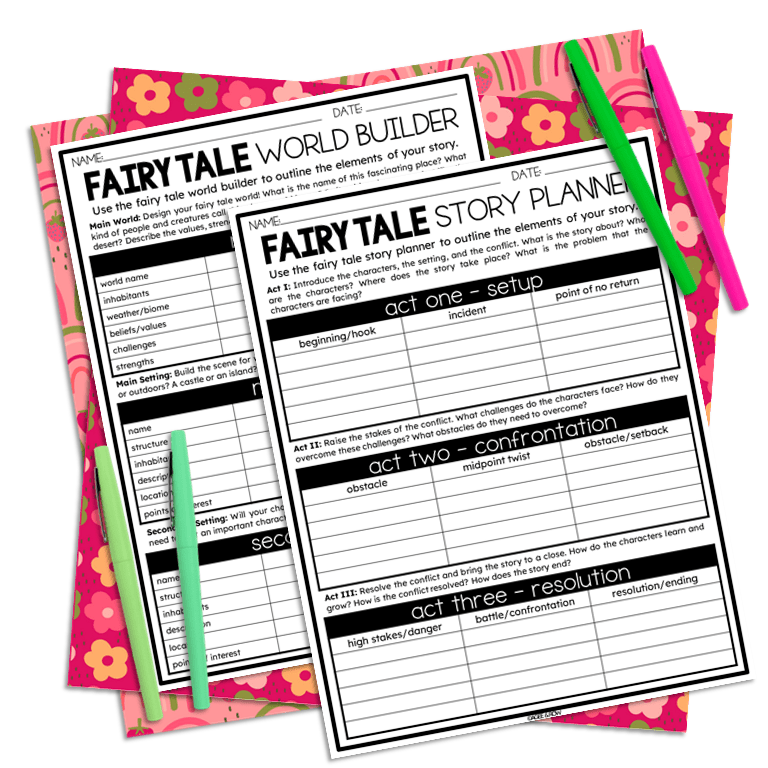
Outline – brainstorm and craft the main elements of their fairy tale with the outline planner. Who is the main character? Which challenges and rewards will their story explore? Lots of themes and keywords are included to choose from.
Character Profiles – students can build up to four character profiles for the heroes and villains in this new fairy tale! Explore personality traits, appearance, hopes and dreams, and more!
Structure – plot the framework for their fairy tale using a simplified three-act structure planner. This is a great way for students to keep their fairy-tale flowing and moving at the right pace.
World Builder – a great fairy tale world is rich in details, creatures, and landscapes. What is the name of this new fairy tale world? Who are its inhabitants? Set the scene for the main and secondary settings.
Themes and Characters – students can explore common fairy tale themes and characters (love, fairy godmothers, villains, good vs. evil, self-discovery)
Settings and Magical Items – from forests to castles to faraway lands, fairy tales can have a wide range of settings, each with its own unique features! Students also learn more about the purpose magical items serve and how to include them.

Grab the Fairy Tale Planner for only $3!

Building a Magical Fairytale World: A Complete Story Planning Guide for Students
Do you need an engaging writing resource for your fairy tale unit? We’ve covered all the elements, characters, and settings for the perfect story. Students build worlds, develop character profiles, and easily map out their very own three-act structure!
Teacher Testimonials
“Thank you for the fairy tale organizers to write a fairy tale. They were very helpful to the students.” Elizabeth Ann H. ⭐⭐⭐⭐⭐
“SO comprehensive, wow!! If you are teaching fairytale writing (or even fiction writing) this is an amazing resource. Pages of super helpful guide/references for the kiddos which really helps them get a jump on their writing. I found this particularly helpful for my kiddos who struggle with creating more interesting (using juicy words) sentences and all of that.” – Ellen H. ⭐⭐⭐⭐⭐

 Agee & Row